InsightForgeMedia • Digital Edition
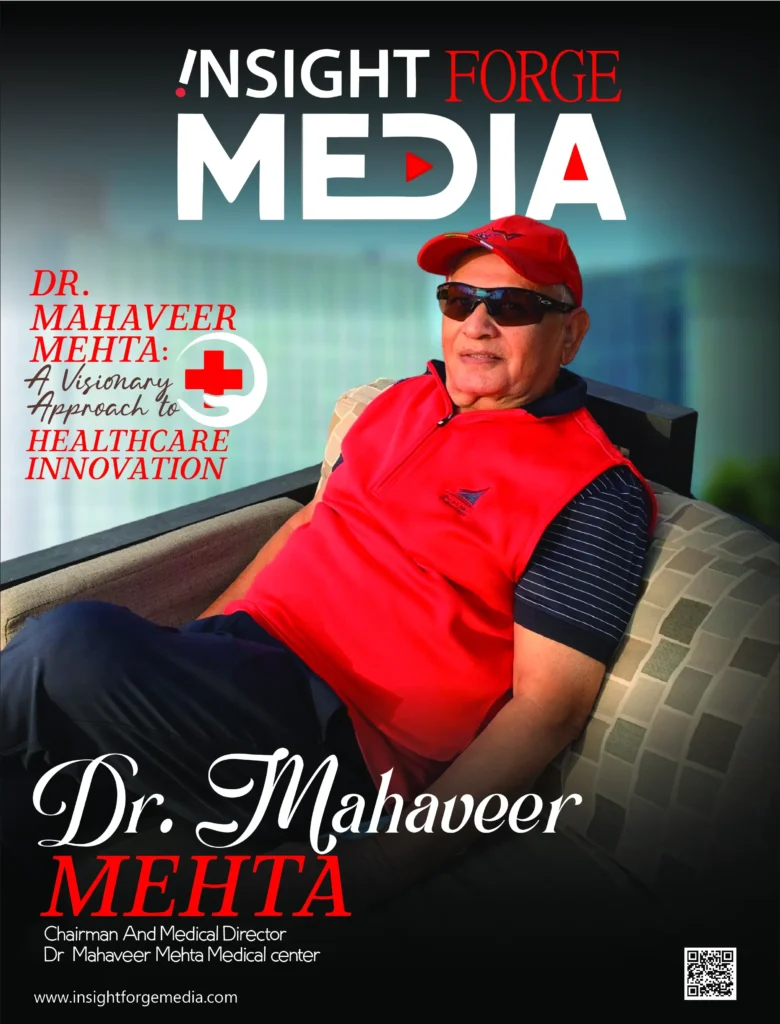
“Dr. Mahaveer Mehta: A Visionary Approach to Healthcare Innovation”
Cover story
Dr. Mahaveer Mehta
Featured Profile - Cathy Warshaw
Dr. Mahaveer Mehta: Where Medical Innovation Meets the Responsibility of Care
Across decades of clinical practice, academic leadership, and technological change, Dr. Mahaveer Mehta has built his career around a defining principle: progress in dermatology must always serve the patient’s best interests.
A Medical Specialty That Demands More Than Observation
Dr. Mahaveer Mehta’s interest in dermatology began with a fascination for the complexity of the human body. As a medical student in India, he recognised that the skin could reveal important information about a person’s health, making it far more than a visible outer layer. The specialty brought together clinical investigation, surgical precision, scientific understanding, and aesthetic judgment, creating a field that continued to challenge his curiosity.
He completed his MBBS at RNT Medical College in Udaipur in 1971. The discipline appealed to him because effective dermatological practice requires a physician to understand the condition before selecting an intervention. Over the years, this early interest developed into a professional commitment that extended across countries, medical institutions, and generations of treatment technology.
His career would eventually encompass academic appointments, departmental leadership, private practice, research, and international medical collaboration. Despite the variety of these responsibilities, the central question remained consistent: how could medical knowledge be applied responsibly to improve patient care?
Lessons Learned in the Classroom and Abroad
Before establishing himself in clinical practice, Dr. Mehta developed his professional foundation through teaching. He served as a faculty member at SMS Medical College in Jaipur and subsequently at Al Fateh University in Tripoli, Libya. These roles strengthened his connection to medical education and reinforced the importance of understanding the principles behind every clinical decision.
Teaching requires more than familiarity with a subject. It demands the ability to explain reasoning, respond to questions, and acknowledge when an answer requires further investigation. This discipline influenced the way Dr. Mehta approached medicine, encouraging him to return to fundamentals rather than rely solely on experience or established routines.
His time in Libya also broadened his understanding of patients and healthcare. Practising in a different cultural environment exposed him to varied expectations, concerns, and beliefs surrounding medical treatment. That experience became valuable as his career moved into other international settings, where clinical knowledge had to be accompanied by cultural awareness and an understanding of different healthcare environments.
From Clinical Practice to Departmental Leadership
Dr. Mehta’s next professional chapter took him into senior positions across the Arabian Gulf. He became Chairman of Dermatology at the International Hospital in Bahrain before heading the Department of Dermatology at the Qatar Armed Forces Medical Unit in Doha.
These appointments required a broader perspective than individual patient consultations alone. Departmental leadership involved supporting other physicians, contributing to clinical systems, and taking responsibility for outcomes delivered through a team. Working within a military medical setting also called for discipline and careful attention to professional responsibilities.
His experience across India, Libya, Bahrain, Qatar, and the United Arab Emirates gradually expanded his understanding of how healthcare institutions operate. It also strengthened his ability to work with colleagues and patients from different backgrounds. By the time he moved into independent practice, he had gained experience as a clinician, educator, and medical leader, each role contributing to the way he would build his own centre.
A Long-Term Commitment to Dubai
In May 1990, Dr. Mehta established his own medical centre in Dubai. The decision came at a time when the city had not yet developed the international profile it would later acquire. Building an independent practice meant committing his professional future to a place whose healthcare sector and wider ambitions were still evolving.
Over the following decades, Dubai underwent significant change, and Dr. Mehta’s practice developed alongside it. He has described the experience of growing professionally with the city as rewarding, particularly through the opportunity to contribute to its healthcare development and international standing.
The centre now operates from Al Ghurair Centre in Deira. Its patient relationships include people who have returned for many years, with some continuing their visits over decades. Such loyalty develops through repeated interactions, consistent care, and confidence in a physician’s judgment. It cannot be sustained by technology or reputation alone.
For Dr. Mehta, maintaining that confidence has required the same attention to individual needs throughout the life of the practice. Each consultation represents a responsibility, and the long-term success of a medical centre depends on how consistently that responsibility is fulfilled.
Introducing Laser Dermatology With Clinical Discipline
Dr. Mehta was among the early physicians to introduce laser dermatology to the Middle East. At the time, the technology was relatively unfamiliar in the region, and its adoption required both professional education and patient confidence. People needed reassurance about safety, while practitioners had to understand the evidence supporting its use and the limitations of the available equipment.
The introduction of laser treatments was therefore not simply a matter of acquiring new machines. It required an understanding of the science, appropriate training, careful patient selection, and the ability to explain what a procedure could reasonably achieve. These considerations shaped his approach as the technology became more widely used.
His medical centre subsequently expanded its treatment range to include skin laser surgery, acne scar treatment, nonsurgical skin tightening, photofacials, intense pulsed light treatments, cellulite treatment, and pico laser technology. The latter has been used for procedures such as tattoo removal and skin rejuvenation.
As the available equipment evolved, Dr. Mehta continued to emphasise responsible application rather than novelty. A treatment’s value depends on whether it is suitable for the patient, not simply on whether the technology is new. That distinction remains central to his approach to innovation in dermatology.
The Questions That Guide Treatment Decisions
Before recommending an intervention, Dr. Mehta considers three essential issues: whether the treatment is scientifically appropriate, whether it is safe for the individual patient, and whether it is genuinely necessary. This approach places diagnosis and clinical judgment ahead of the desire to perform a procedure.
The question of necessity carries particular importance in aesthetic medicine. Patients may seek changes to visible features, and the industry can encourage the idea that every perceived imperfection requires correction. Dr. Mehta takes a more measured position. A laser is a tool, not a diagnosis, and the same technology can produce different outcomes depending on the patient’s condition, skin type, treatment settings, and expectations.
His approach to individualised care rests on accurate diagnosis, appropriate technology, proper technique, realistic expectations, and careful follow-up. These elements work together to ensure that the proposed treatment is based on the patient’s circumstances rather than on a generalised promise of results.
He also recognises that a decision not to proceed can be the most appropriate medical recommendation. Observation, conservative treatment, or explaining why a procedure is unnecessary may serve a patient better than intervention. Choosing that course, even when it means foregoing revenue, reflects his belief that clinical responsibility must come before commercial opportunity.

Remaining a Student of Medical Progress
Dermatology has changed considerably during Dr. Mehta’s career. Conventional diagnosis and treatment have been joined by dermatological surgery, energy-based devices, and increasingly advanced aesthetic procedures. Keeping pace with these developments has required continuous learning while managing the responsibilities of clinical practice and an independent medical centre.
He believes that experience cannot justify complacency. Medical knowledge continues to evolve, and physicians must update their understanding if they want to maintain sound clinical judgment. Years in practice can provide perspective, but they do not remove the responsibility to study.
Dr. Mehta has maintained this commitment through international dermatology and laser conferences, academic presentations, professional teaching, mentoring, and research. His published work includes more than fifteen articles in scientific journals. He has also served on the editorial boards of dermatology journals, contributing to the wider exchange of professional knowledge.
His recognitions include the Physician Recognition Award from the American Medical Association and the Continuing Medical Education Award from the American Academy of Dermatology. His professional engagements have included invitations to participate as a chair, speaker, and faculty member at international congresses, including a gender aesthetic congress in Singapore in 2014 and a dermatology and laser congress in Cannes, France, in 2015.
These activities reflect a career that has remained connected to education and scientific discussion alongside direct patient care. For Dr. Mehta, professional development is not separate from practice. It is one of the responsibilities that makes good practice possible.
Creating Opportunities for International Medical Exchange
Dr. Mehta’s contribution to dermatology has also involved bringing professionals together to exchange knowledge across borders. His involvement with the Dermatologic & Aesthetic Surgery International League, a United States-based nonprofit organisation, provided an opportunity to contribute to international professional collaboration.
He served on the organisation’s Board of Directors from 2013 through 2016 and advocated for holding its annual conference in Dubai. The proposal was accepted, and he was appointed Congress President for the October 2016 meeting, held with the support of Dubai Tourism and the Government of Dubai.
Organising an international medical congress required coordination across scientific programming, speakers, sponsors, logistics, and delegates from multiple countries. Dr. Mehta also chaired the scientific committee of the International Congress in Aesthetic and Anti-Ageing Medicine, known as ICAAM, across several years beginning in 2013.
His work received recognition at the 2016 conference, when the American Society for Dermatologic Surgery presented him with an Outstanding Contribution Medal. Dubai Tourism and the Government of Dubai awarded him the Congress Ambassador Award for his efforts in attracting and hosting international conferences, an honour he received again in 2020.
These achievements extended his work beyond clinical practice. They helped create opportunities for international medical exchange in Dubai and reflected his belief that the profession advances when specialists share knowledge, experience, and research rather than keeping their expertise within individual institutions or countries.
Public Awareness as an Extension of Medical Care
Dr. Mehta’s involvement in healthcare extends beyond his medical centre. He is a former Board Director of the Rotary Club of Dubai and has maintained an interest in humanitarian and philanthropic activities.
Skin cancer awareness has been another important part of his public health efforts. His message focuses on prevention, early diagnosis, and timely medical assessment. A changing mole, a persistent lesion, or unexplained pigmentation should not be ignored simply because it is painless or appears to be a cosmetic concern.
These concerns illustrate why dermatology must be understood as more than a specialty associated with appearance. Skin health forms part of overall health and wellbeing, and appropriate assessment can help identify conditions that require medical attention. Awareness and early evaluation are therefore important parts of responsible healthcare.
For Dr. Mehta, educating patients and the wider public is a natural extension of clinical work. Helping people recognise when they should seek medical advice is as relevant to patient welfare as explaining the options available once they enter the consulting room.
A Standard for the Next Generation
Dr. Mehta’s advice to young physicians begins with a clear priority: pursue excellence rather than recognition. He encourages them to master medical fundamentals, establish an accurate diagnosis before treatment, and understand the science behind every procedure they perform.
He also warns against allowing marketing trends to determine clinical choices. New technologies can expand the options available to dermatologists, but they must be adopted with appropriate knowledge and judgment. He expects artificial intelligence and increasingly sophisticated machines to influence the field, while emphasising that ethical conduct, communication, patient safety, and clinical understanding will remain essential.
Professional reputation, he believes, takes years to establish and can be damaged by a single careless decision. Technical ability must therefore be matched by responsible conduct and clear communication. Patients need physicians who can explain the reasoning behind a recommendation and recognise when a proposed intervention may not be appropriate.
This approach places long-term credibility ahead of short-term attention. For Dr. Mehta, a successful physician is not simply someone who can perform a procedure, but someone who understands when it should be performed and can put the patient’s welfare first.
Continuing the Work Through Education and Mentorship
More than four decades into his career, Dr. Mehta remains focused on sharing knowledge, educating patients, and helping younger dermatologists develop a responsible approach to practice. His future priorities include academic collaboration, scientific exchange, and the careful adoption of emerging technologies.
Rather than viewing professional recognition as an endpoint, he regards it as a reminder of the responsibility to continue contributing. Medicine remains a field in which learning is ongoing, and he continues to value the opportunity to understand new developments and pass knowledge to others.
His journey has taken him from medical education in India to academic and leadership appointments abroad, followed by the establishment of a long-standing practice in Dubai. Along the way, he has contributed to clinical innovation, research, professional collaboration, and public health awareness. The different stages of his career have reinforced a common principle: medical progress depends on both knowledge and the judgment to apply it appropriately.
Patient Confidence as the Enduring Achievement
Dr. Mahaveer Mehta’s professional record includes senior dermatology appointments in Bahrain and Qatar, a medical centre established in 1990, an early role in bringing laser dermatology to the Middle East, international congress leadership, research contributions, and recognition from medical organisations and the Government of Dubai.
Yet the measure he values most is the trust of his patients. Titles, awards, and technologies may change over time, but a physician’s responsibility remains constant: listen carefully, diagnose accurately, communicate clearly, and recommend treatment that serves the individual.
His advice to patients follows the same reasoning. They should not choose a procedure simply because it is fashionable or advertised as the latest innovation. They should seek a qualified and experienced professional who can assess whether treatment is necessary and explain the available options. The goal should be safe, natural, medically appropriate results rather than change for its own sake.
Throughout his career, Dr. Mehta has sought to bring innovation into dermatology without allowing technology to overshadow clinical judgment. His lasting contribution lies in maintaining that balance, advancing the possibilities of treatment while keeping patient wellbeing at the centre of every decision.